
Recently, I had an opportunity to see someone I hadn’t seen in 48 years. I’m going to tell you in a moment what I asked him, but here’s the important part: his reply was, “Don’t break me. Don’t break me.”
What could I possibly have asked him?
Forty-eight years ago, was the very last time I saw one of my high school teachers. It’s interesting what stays with you through an entire lifetime—those single moments when you learned something that carried you forward every single day afterward. And I’m going to get to the question I asked him whose answer was simply, “Don’t break me.”
I grew up in a very small town called Le Sueur, Minnesota—the very birthplace of the Minnesota Valley Canning Company that became the Green Giant Company early in the last century. Some of you may know the town for exactly that reason. The jobs I had there were during the summer months. As soon as school let out, you began working at the canning factory, and we were actually thrilled about it.
Prior to that age, kids my age worked in the fields because that’s where you could make money. We picked rock, we detasseled corn, and we did something called “walking beans”—a simple way of saying we carried garden hoes and walked up and down bean fields making sure the weeds were taken care of. Nowadays all of that is handled with chemicals, but back then you gathered a whole crew of kids and walked those fields for very, very little money.
I can still remember my very first paycheck at age 11. After three weeks in the field, I made $72—and I was thrilled. My mother made me put every penny into a savings account that I wasn’t allowed to touch until I turned 18 because, she said, “You’re supposed to save for higher education.” Those were the rules. That was the discipline instilled in us.
But as soon as we turned 16, we were thrilled to move inside the factory. No more hot sunshine all day. The shifts were simple: seven to seven—either 7 a.m. to 7 p.m. or 7 p.m. to 7 a.m. Every two weeks the schedule flipped. You just kept rotating all summer long until school started again in the fall. Even then, the factory kept running, and moms and other part-time workers would step in to take the jobs we’d held all summer.
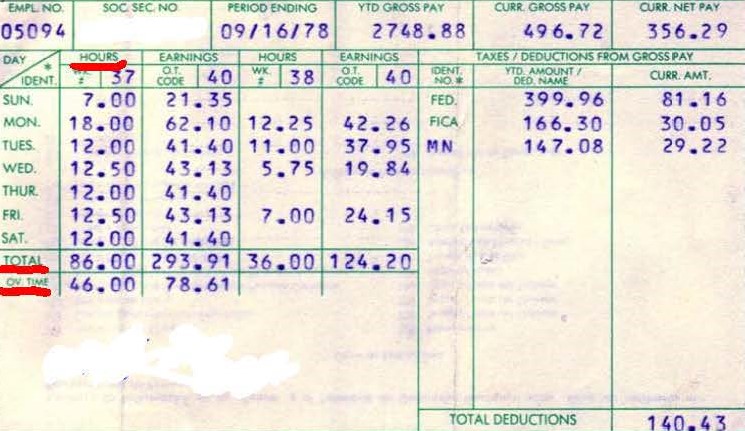
That work taught me—and a lot of us—the tenacity to simply keep going. Twelve-hour days were no big deal. In fact, I still have one pay stub showing 46 hours of overtime in a single week—86 hours total. That’s probably illegal now, but it taught me something money can’t buy: the value of hard, consistent effort. By working that many hours, you were exhausted the rest of the time. So life was eat, sleep, work, and repeat.
Let’s get back to the teachers.
One teacher taught me typing—back when it was still called typing, not keyboarding. His name was Mr. Rapp. I can still hear myself repeating “F, F, F space, J, J, J space” for an entire semester. I use that skill every single day.
But the teacher I reconnected with after 48 years was Mr. Gordon Gregerson. In a small town like Le Sueur, you often had the same teacher for years. He was my choir teacher from seventh grade through twelfth, and for the last three years, he was also my homeroom teacher.
You might be thinking, “Mark, how often do you sing?” There were times I felt like I was singing for my supper when money was tight. But Mr. Gregerson taught me something far more valuable than notes on a page: he taught me how to present myself. I still talk to my team members about these lessons every single day. In fact, just today I spoke to an organization during my lunch hour and brought him up because of the way I try to show up for every client and every audience.
Mr. Gregerson taught me three simple but powerful things:
Number one: Smile. You could never see his face from the audience, but the choir always saw it. He told us, “Smile, because people can literally hear the difference in your voice if you simply smile.”
Number two: Stay relaxed. He never wanted us to feel uptight. He’d watch people clench their fists, and he’d say, “Take your thumb and your middle finger and let your hands rest relaxed at your sides.”
And number three: Bend your knees. When you’re standing, speaking, or singing, bend your knees slightly so the blood keeps flowing to your brain, and you don’t pass out. I’ve seen it happen in choir concerts—someone locks their knees and down they go. To this day, before any presentation, client meeting, or even a tough conversation, I catch myself: Smile. Relax. Bend your knees.
So, when I finally had the chance to see Mr. Gregerson again after 48 years, I didn’t recognize him at first. He introduced himself. I asked, “Can I give you a hug?” And without missing a beat he replied with that unforgettable line: “Just don’t break me.”
I laughed, hugged him gently, and said, “Thank you for the lessons you taught me.”
Those lessons—smile, relax, bend your knees—aren’t just stage tricks. They are life skills. They show up every time I sit across from a family who is trying to figure out how to protect what they’ve built, how to grow their money without losing sleep, or how to make sure their loved ones are taken care of when they’re gone.
In my work at Financialoscopy®, I’m not just running numbers or recommending products; I’m helping people tell the next chapter of their family’s story—the same way my grandparents and parents told ours through decades of hard work at the Green Giant plant and on the farm. The work ethic I learned walking bean fields and pulling 86-hour weeks in the canning factory is the same tenacity I bring to building financial strategies that last.
And the presentation skills Mr. Gregerson drilled into a small-town choir kid? They help me deliver complicated financial concepts in a way that feels human—clear, warm, and trustworthy. Because when you smile, stay relaxed, and keep the blood flowing to your brain, people don’t just hear your words. They feel your sincerity.
That brief reunion reminded me why I do what I do. The same small-town values that once had an 11-year-old thrilled about a $72 paycheck still guide every Financialoscopy® we perform today. We focus on character, discipline, and long-term thinking—the very things my family lived by and the very things Mr. Gregerson helped me practice on stage.
If you’ve ever wondered whether your financial plan truly reflects the life you’ve worked so hard to build, I invite you to schedule your own Financialoscopy®. It’s more than a review. It’s a clear-eyed look at where you are, where you want to go, and how to get there—while remembering to smile, stay relaxed, and keep moving forward.
Because the lessons that last a lifetime aren’t always the loudest ones. Sometimes they come from a choir teacher who simply says, “Don’t break me”—and in doing so reminds you to handle every relationship, every responsibility, and every opportunity with care.
Thank you, Mr. Gregerson. And thank you to every client who trusts our team with your family’s financial story.
Ready to write the next chapter? Schedule your Financialoscopy® today.